
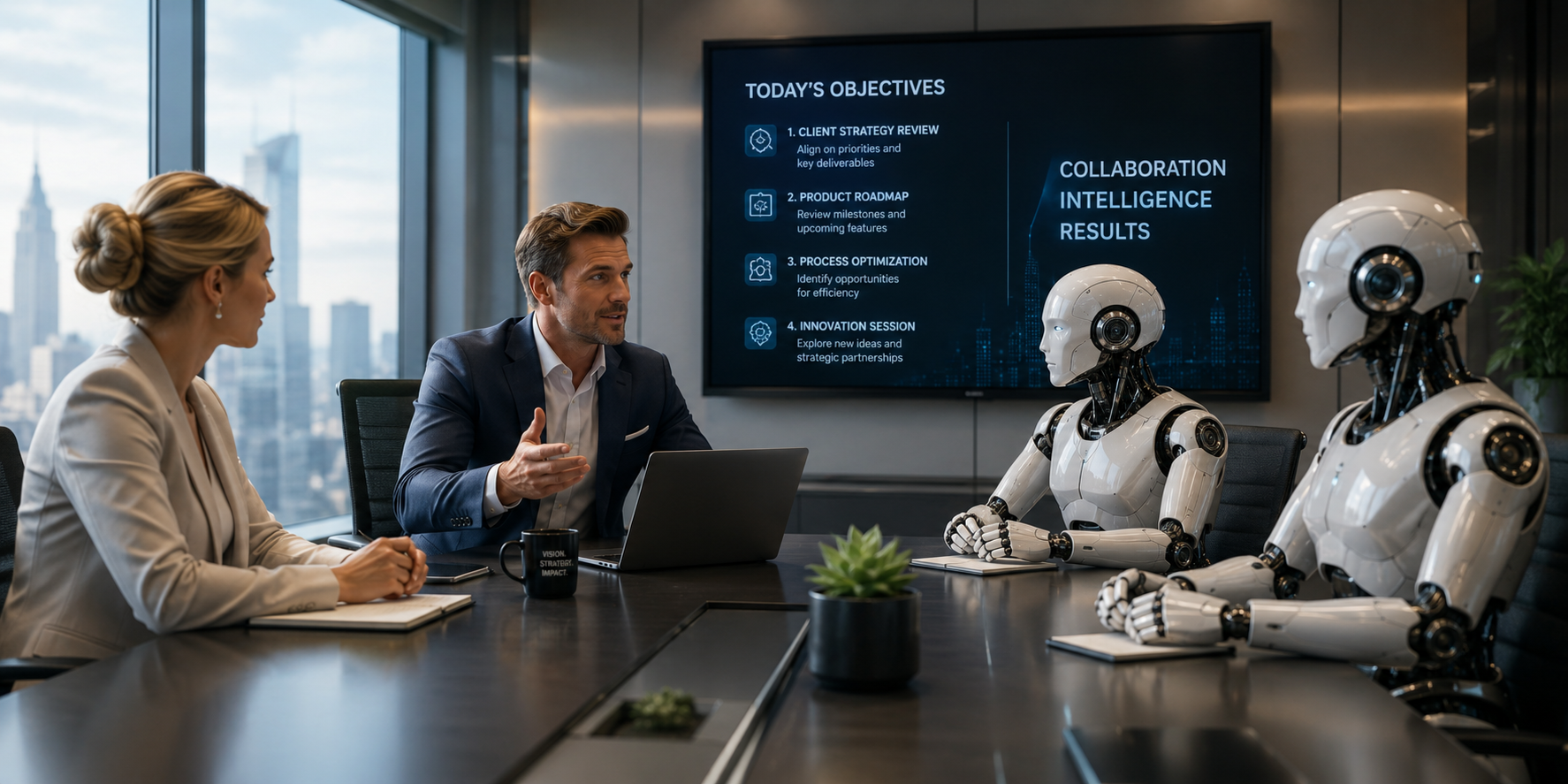
AI Changes Everything … Or Does It?
Are you an AI optimist or an AI doomster? Both enthusiasm and trepidation are understandable.
For the first time, businesses have access to non-human agents or employees that can write reports, analyse data, answer customer questions, generate software code, create marketing content and perform a growing range of tasks that were previously the exclusive domain of humans.
The productivity and innovation gains will be substantial but so are the management risks. Organisations that use the AI tools effectively are likely to gain significant advantages in speed, cost and innovation. They will transform their businesses – and their industries – in the process.
Yet amid the excitement, it is worth asking a slightly different question. What if we treated AI not as a mysterious new technology, but as a new recruitment wave?
Imagine that tomorrow your organisation hired a large number of new employees. Some are exceptionally bright. Some possess specialist expertise. Some can produce work at extraordinary speed. Others are helpful but require close supervision. Some appear to be from another planet. As with any group of new recruits, their success would depend not only on their capabilities, but crucially on how well they are onboarded, directed and managed.
Viewed through that lens, the management response to AI would look surprisingly familiar.
Meet Your New Employees
Consider some of the most common AI tools currently entering organisations.
| AI System | New Employee Equivalent |
| ChatGPT | A bright graduate analyst: articulate, enthusiastic, fast learner, capable of producing impressive work, but occasionally confident when wrong |
| Codex or coding agents | A brilliant PhD-level software developer: highly technical, productive and knowledgeable, but with limited understanding of your business, customers or commercial objectives |
| Research agents | A junior consultant: able to gather information rapidly and produce useful summaries, provided the brief is clear |
| Sales chatbot | An outsourced call centre representative: available 24 hours a day, generally consistent, but requiring scripts, training and quality assurance |
| Content generation tools | A capable marketing coordinator: creative, productive and willing to generate endless variations, though not always aligned with brand standards |
Most managers instinctively understand how to work with people like these and for some big employers or fast-growing companies might have experience of onboarding waves of new recruits.
You would not expect graduate analysts to understand every nuance of your business on their first day. You would not hand unrestricted authority to new employees without supervision. You would not assume that every recommendation from consultants is correct. And you would certainly not allow an outsourced customer service provider to communicate with customers without training, scripts and quality controls.
That’s why organisation put in decision authorisations, approvals, role definitions and a whole architecture of governance and management. The goal is not only to manage and control but to optimise and innovate aligned to the company strategy.
The analogy is not perfect. AI employees never sleep, can be replicated infinitely, possess no organisational loyalty and cannot be held accountable for their decisions. Yet for a manager deciding how work gets done, the comparison remains surprisingly useful.
The Management Challenge Isn’t New
Many disappointing AI implementations are not technology failures. They are management or organisation structure failures. Organisations deploy powerful AI tools without defining objectives, clarifying expectations, establishing review processes or setting decision-making boundaries. When the results are inconsistent, they conclude that AI is unreliable.
In reality, they have simply skipped the management disciplines that they would apply to any human worker.
Provide Role Descriptions and Authorisation Levels – Good employees of all kinds perform best when they understand what success looks like and how to operate in a team. Scope of work, expectations, review points and approvals all need to be defined.
Train the Managers of Employees – Managers need to learn how to allocate work between humans and, in the new world, between humans and AI. They need to understand where AI excels, where it struggles and when additional oversight is required.
Review Before Going Live – One of the oldest management principles remains one of the most important: trust, but verify. This is not because AI is uniquely flawed. Humans make mistakes too. The difference is that managers already understand the need to supervise people. They must develop the enhanced skills for supervising AI and have the confidence to direct AI when needed.
Creativity Requires Alignment – In some roles, employees with new ideas and out-of-the-box thinking drives innovation and growth. But the creative spark needs to be aligned to strategy and the rest of the team. So with humans and especially with AI.
What Is Different?
This is not to say that AI changes very little. That would be naive.
The management disciplines may be familiar, but the characteristics of AI are not. A poor employee might send one incorrect email. A poorly supervised AI system might send ten thousand. An inexperienced employee occupies one position on the organisational chart. A single AI system can be replicated instantly across an entire enterprise.
The scale, speed and reach of AI fundamentally amplify both opportunity and risk.
The organisations that succeed with AI will not simply possess the best technology. They will possess managers who know how to define roles, communicate expectations, supervise work, establish authority limits and continuously improve performance. There will be new skills to master including technical controls, information architecture, data governance and engineering disciplines that extend beyond traditional management.
They will also excel at the same disciplines that have always underpinned effective management.
That is why organisations need stronger controls, clearer accountability and better management practices than ever before. Not because traditional management has become obsolete, but because its importance increases in the AI world.The base skills required are remarkably similar; the consequences of getting them wrong are not.
AI used for analysis, drafting and review. Insights, errors, and conclusion are the responsibility of the author.